I have been programming since I was eleven: web apps, networks, embedded systems, security, whatever I could get near. It paid early: at fourteen a bank commissioned a month of animation work from me, and through school I fixed and rebuilt computers for money. A proximity unlock system I built took first place at Ukraine's state robotics competition, and I took a first place in stage one of Ukraine's National Olympiad in Informatics, individual and team. At sixteen, Genesis Tech, one of Ukraine's largest tech companies, admitted me to its startup school as the youngest in its history, roughly 3% get in, and I led a six person team to an education startup MVP there, and after finishing an Argonne National Laboratory training program in nuclear science I did my own research into synthesizing Tc-99m, the workhorse isotope of cancer diagnostics, from nuclear plant waste.
Then the war reached Dnipro. I learned the nuclear power station near my city had been shelled while sitting in the basement of a bomb shelter; later, the first ICBM ever used in war landed a quarter mile from my house. We drove out: ten days from Dnipro to Alanya, sleeping at gas stations and border crossings; I spent the ride reading Hawking’s A Brief History of Time.
Turkey held us for half a year, and every application deadline had already passed. So at seventeen I cold emailed for months: hundreds of boarding schools and summer programs. That stretch won me full scholarships to the BlueStamp and Northeastern engineering programs, where I built robots, one seeing through computer vision; and a full ride from a boarding school in Iowa. That same summer, from Boston, I advised the CEO of Brave Action Ukraine, a wartime nonprofit, on strategy and partnerships. A year later, Notre Dame, as a QuestBridge Scholar.
When the front door is shut, I write to everyone who owns a side door, and I do the work when one opens.
Ten days by road, Dnipro to Alanya. Months of cold emails from Turkey. A month in Boston; Fairfield, Iowa; then Notre Dame.
age 11First code. Web apps, then networks, embedded systems, security.
lyceumFirst place at Ukraine's state robotics competition; competitive programming with the school team.
2021Argonne National Laboratory training program, then my own isotope research.
age 16Youngest admit in the history of Genesis Tech’s startup school.
2022War reaches Dnipro. Ten days on the road to Turkey; months of cold emails; two engineering scholarships and an Iowa full ride answer.
2023Notre Dame, as a QuestBridge Scholar.
02
Notre Dame
Computer science, GPA 3.868, graduating May 2027. Notre Dame started picking me before I arrived: an IDEA Center Fellow, about fifteen students a class, chosen with Admissions before matriculation. Three years later I sit on the other side of that table as the IDEA Center’s Technical Lead Startup Coach, scoping MVPs and architecture for real founders.
Companies kept picking me too. Microsoft, through the Student International Business Council, had me research what agentic AI does to its Cloud and Gaming workloads. This fall I start undergraduate research in the S2E security lab, finding vulnerabilities with machine learning. And one relationship kept compounding:
VISA
2024Selected for the inaugural Visa Fintech Foundation cohort.
2024-25Researched CBDC and stablecoin integration for the US market.
jan 2025Presented to Visa’s C-suite; met CEO Ryan McInerney.
nowMoving to sponsor the accelerator I run.
One company, three escalations.
03
What I built while studying
Three things, overlapping. A company I co-founded and built the engineering of end to end, a founding engineer sprint at a second startup, and a programme that turned Notre Dame's best students into placed engineers.
Tweeds/2024–2026/co-founder, founding engineer
internal, not public
Built the production pipeline that replaced a four week manual process with minutes
The product turned a book manuscript into a finished, search optimised Amazon listing; publishers were paying a copywriter and waiting about four weeks per book. For two years I built and ran the engineering end to end by myself, then hired and ran the interns who maintained it.
Independently runnable stages with typed data between them, so any one can be rerun without replaying the rest.
The hard parts, specifically
Amazon's category taxonomy has ~14,000 nodes and shifts under you. I designed the categorisation algorithm that survives that: embedding retrieval plus union find clustering on cosine similarity, so listings stay correctly placed as the taxonomy changes underneath.
The hardest part was making “good” measurable. A listing is only good if a number says so, and no such number existed; I had to design the quality metric, then build the feedback loop that moves it. Market signals arrive on their own schedules, from Amazon’s API to scraping to open source intelligence, and have to be merged into one picture. Keywords are scored on market data, semantic relevance and the realistic odds of winning the rank, then the live set is re-ranked continuously; titles, subtitles, descriptions and even the cover choice feed off the same loop. From a 200,000 word manuscript to a listing that measurably improves week over week, every stage automated.
Under it, infrastructure: provider agnostic LLM routing across Claude, OpenAI and Gemini with schema validated outputs, automatic retry, and per call cost tracking; scraping under cost governance, idempotency keyed and budget capped in cents.
Security was audited, not asserted: I closed the audit by shipping row level security across 13 tables and a prompt injection guard on LLM inputs.
Beyond the code: interviewed 12+ candidates from 60+ applicants, wrote the code review rubric and CI gates, promoted the strongest hire to subsystem lead, and wrote the architecture decision records.
Desync AI/summer 2026/founding engineer
internal, not public
Merged 260+ pull requests in my first month as a second startup’s founding engineer
A Rust, Python and Postgres platform. I owned every layer a product stands on; the stack below is one person’s first month.
260+PRs in month one70Bself hosted inferenceH100cluster
productAsync streaming chat agent; a feature flag system with safe rollout controls.
gpu infraSelf hosted 70B model inference on an H100 cluster.
paymentsPayments and billing.
ci/cdDeployment automation, commit to running service.
observabilityLogging and metrics across the platform.
securityHardening across the stack.
Founding engineer scope, drawn out: one person owning every layer at once. That is where the 260+ first month pull requests went.
What a founding engineer month contains
The 260+ pull requests were not one system. They carried the billing and payments path, the CI/CD and deployment automation for every service, the observability and the security fixes, and the GPU cluster itself: provisioned, hardened, and serving a self hosted 70B model in production.
More specifics belong in a conversation, not on an indexed page.
The founder track that came with it
The same summer, Notre Dame's Race to Revenue accelerator selected me as a founder with a $6,000 grant; I built the product the venture went to market on and pitched at Chicago Tech Week, working the accelerator's investor and operator bench through its sales curriculum: prospecting, discovery, close.
Before either company’s biggest summer, in February 2025, I founded the Innovation Sprint Lab: a student accelerator where teams ship production software for real companies, under weekly sprints and senior industry mentors. My idea, my programme; I raised $10K+ in funding plus cloud credits for the first cohort by convincing people who had no reason to bet on a sophomore.
Justin HintzVP, Teamworthy Ventures: invested his time
a founderof a $4B company: invested his time
a veteran VCat a large DC fund: funded it
IDEA Centergave it a home
Who bet on a sophomore, and with what.
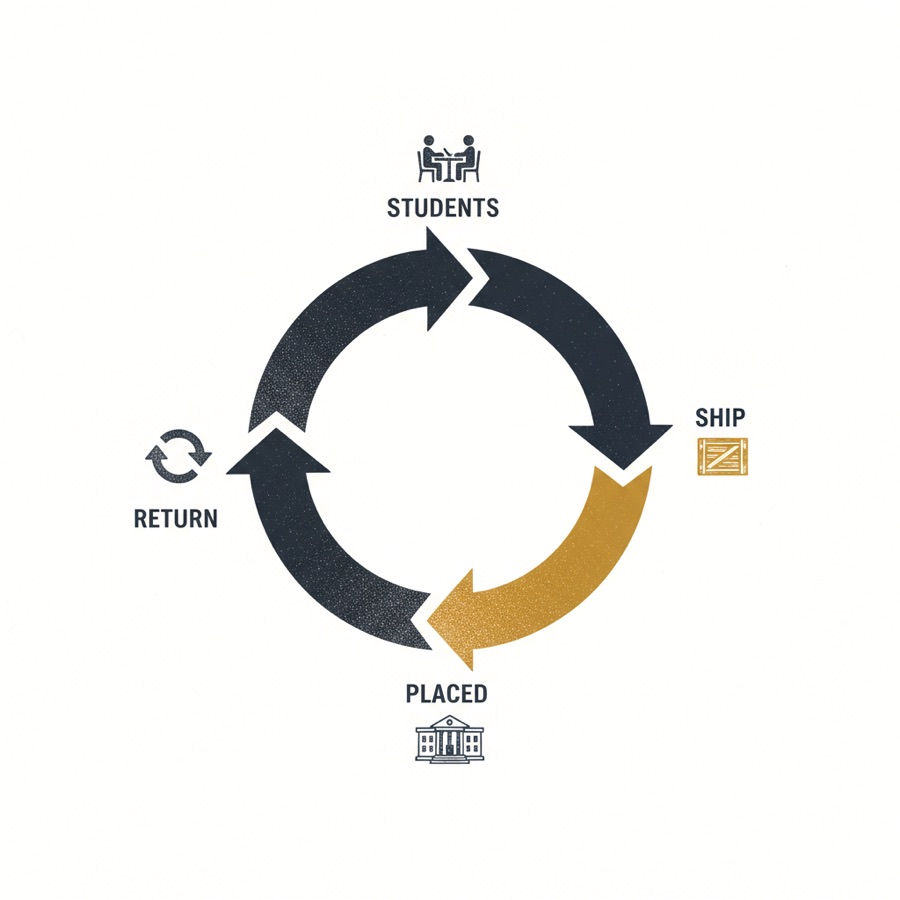
The loop the lab runs on: students ship, finishers get placed, the companies come back with harder problems.
Fall 2025 cohort/the first one/proof of model
public post
Seventy applied, fifteen got in, and every one who finished landed a job
70applied
27technical interviews, run in days
15selected, waitlist still active
100%of finishers placed
Placements went to NVIDIA, AWS, Boeing, IBM and Visa. Several arrived already carrying experience from places like the CIA and 84.51°.
Who mentored them, and what shipped
ClickUp mentored two teams directly, through co-founder and CTO Alex Yurkowski. Teamworthy Ventures embedded a third team inside a portfolio company's codebase, with its VP Justin Hintz plus an ex-Meta engineer. The bench also carried a CTO in Residence who had been a WebMD director of engineering and a Y Combinator co-founder, and a Notre Dame adjunct professor who leads product at a studio.
At Demo Day, Tim Connors, founder of PivotNorth Capital and formerly of Sequoia Capital, joined Alex and Justin to give teams direct feedback. Alex publicly congratulated the top performers; Justin put up a cash prize for the strongest student. ClickUp offered to fast track hiring, Teamworthy offered portfolio company introductions.
One team shipped Smart Invoice AI and cut a partner's invoicing time by more than 80%.
The lab’s orbit: where finishers landed, who mentored, who judged, who partners.
SprintHack@ND/nov 2025/ai workflow
named reference
Ran a hackathon as a talent funnel, and got industry to judge it
A talent funnel disguised as a weekend. Judged by a venture investor, Google and Amazon alumni.
$5Kprizes raised12teams60+participants14judges
2026–27/next/full year programme
committed, not yet run
Unified four campus organisations, about 300 students, into one programme
Now the lab turns outward, to grow the region's tech ecosystem: local businesses get engineering they could not hire, and the engineers get a reason to stay. Four clubs that had never run anything together share one cycle, kicking off with an open hackathon October 3–4. Goodwill Michiana is the first embedded partner: a team ships their first automation this semester (a weekly vendor report that costs a full day by hand) inside their plan to scale from $50M to $100M, mentored weekly by Goodwill's CEO and an ex-Amazon technical PM. September opens the year with lectures and mentorship sessions; the booked speakers so far include a startup lawyer, a high frequency trader, and an engineer from GitHub.
Fetched from GitHub when you load the page; the grid grows as the account does.
leverage, measured
The other half of the output: I run AI agents the way most people run a terminal. 9.4 billion tokens of Claude, cached context included, across 95 active days; 1,847 sessions, a 45-day longest streak. That is roughly 35,000 copies of Moby-Dick of working context: agent fleets doing audits, migrations and research while I review. This page, its map, its build pipeline and the deep research behind it were all made that way.
Daily token volume from this machine's logs, darkest at the heaviest days; refreshed nightly. Green above is code shipped, ochre here is the leverage behind it.
six weeks at clickup
ClickUp, a roughly $4B company, had never taken an intern. Their co-founder and CTO Alex Yurkowski broke that policy for me in the summer of 2026, after a year of mentoring my accelerator’s teams; the door opened through the lab. Six weeks embedded with the chat team on platform work; here is what happened in them.
ClickUp/2026/week one
internal, not public
Found a P0 security vulnerability in my first week
Six days into a company that had never taken an intern, in a codebase I had not written.
P0highest severitywk 1found in
ClickUp/2026/platform
internal, not public
Moved thousands of feature flag definitions through production cutover inside a two minute freeze window
The platform every engineer ships features through. I ran the cutover myself.
The bar is the migration. The ochre mark is the production freeze, drawn to scale: under two minutes. Everything either side of it served traffic normally.
How it was verified
Seven stacked reviewed pull requests, roughly 900 lines of production code against roughly 2,900 lines of tests.
Byte-exact verification across about 1,900 field values, plus zero-write idempotency checks against a staging replica I built myself, before every release.
The related sync enriched about 3,400 flag records with eight metadata fields: per environment configuration and custom targeting landed in dedicated fields, and created-at dates were backfilled write-once so history could never be silently rewritten.
The design principle behind all of it: make every step small, reversible and independently verifiable, and the scary cutover becomes routine. That is the tradeoff I will defend in any system review.
ClickUp/2026/integration
internal, not public
Caught an undocumented vendor API behavior that would have silently corrupted every running experiment
Undocumented, silent, and only under load. I drove it into the vendor's own engineering org until they shipped a fix.
everyrunning experiment at risk~900req/min ceiling proven0dropped writes
What else the probing found
Three further undocumented API contract requirements, found by empirical probing rather than documentation, with fixes contributed back.
Load-tested the real rate ceiling at a sustained ~900 requests per minute with zero dropped writes, which is the number the cutover plan was built on.
ClickUp/2026/rescue
internal, not public
Restored CI that had failed every pull request for months, and took the suite from 139 tests to over 530
Nobody had touched it in months, so nobody could change anything safely.
139 → 530+tests24PRs in 4 weeks10dependency vulns patched
What I changed about how it ships
Four of the ten dependency vulnerabilities were high severity. The same service also threw an urgent production data-correctness bug one day; I root-caused it and shipped a self-healing rollout the same day, no manual backfill.
Alongside the test suite I introduced automated AI code review on the repository, so the standard held after I left rather than decaying back.
ClickUp/2026/agents
internal, not public
Built the agent fleet that cleans a flag platform up after itself
The full lifecycle, automated: dashboards surface flags with no traffic in 30 days, split by frontend and backend environment; agents resolve the owning squad and engineer, ping them, open the removal pull request across repositories, and retire the flag from the platform itself. Every write sits behind canary verified gates and a no-writes-on-uncertainty policy, so the fleet fails closed. It shipped as part of ClickUp Brain.
The 330x was justified against a thousand recorded production run durations, not a sample, and it survived a 79 minute scheduler delay in production that would have broken the alternative design I had rejected.
Under the fleet: a standalone code-reference scanner that gives every flag a has-code-references verdict, and a weekly last-traffic refresh feeding the dashboards. The removal agents drove Cursor across repositories to open the PRs, with squad and owner resolution deciding who gets pinged and who reviews. I also ran the evaluation of self hosted versus hosted MCP servers for how agents should reach internal tooling, and the reminder and cleanup cycle ran end to end without a human starting it.
05
See for yourself
The ClickUp work is behind private repositories; you have to take my word for it. These you do not. Each was cloned, built and run on my machine, and everything below is real output. This is for whoever you forward this to.
CoreMetrics/C++23, SDL3/macOS, linux, windows
repo, LGPL
Wrote a widget toolkit on raw pixel surfaces, then a cross platform system monitor on top of it
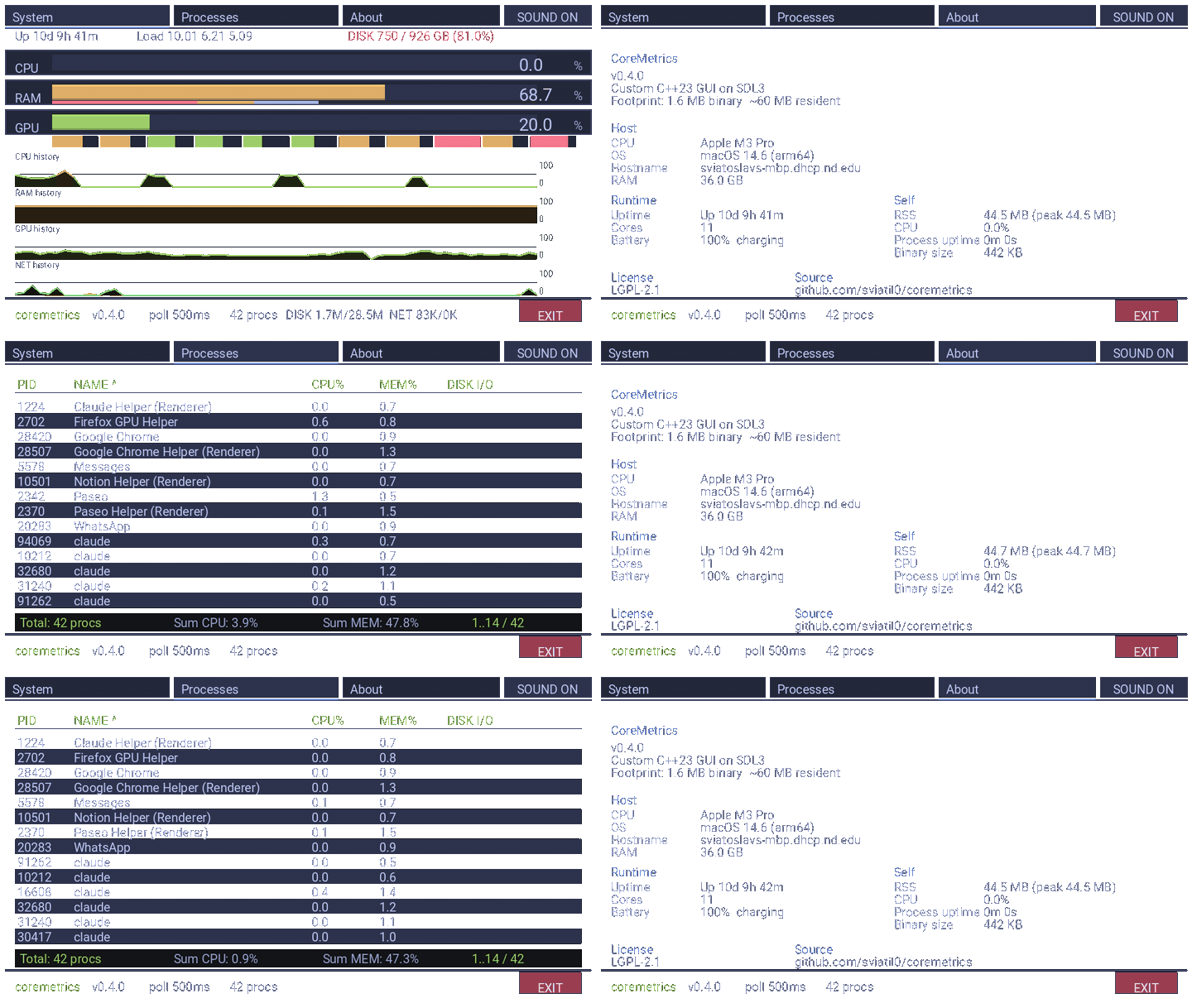
A system monitor with no UI framework underneath: no Qt, no Electron, no Skia. Text layout, hit testing, event dispatch, redraw; I rasterised every glyph and line on screen myself. The About tab paints the app's own live footprint, so every screenshot doubles as evidence.
92%of the source, mine1.6 MBon disk33test suites3platforms in CI
System, processes, about. Every frame is a real paint, produced by the binary's own headless screenshot mode.The design worth a look
Four person Notre Dame software engineering team, three months, per developer branches behind a PR template and required review; I led it and wrote most of the source.
The widget hierarchy uses CRTP: every element inherits Cloneable<Self> rather than the base directly, so a deep clone() and a covariant cloneDerived() come for free instead of being written out per class.
mini-allocator/C/malloc, free, realloc, calloc
repo, MIT
A drop in allocator with segregated free lists, and a test suite that proves it
Segregated free lists, boundary tags, coalescing on every free through the footer trick. Below the test run: the same C compiled to WebAssembly, so you can poke the heap yourself and watch it split and coalesce.
chat over a message queue/C, pthreads/producer consumer
repo
A concurrent message queue client, stress tested with twelve threads fighting over it
A thread safe blocking queue under a pub/sub client: mutex and condition variable, timed waits, and a shutdown broadcast so blocked consumers wake and exit clean instead of hanging forever. Background pusher and puller threads move requests over HTTP long polling; a terminal chat app rides on top.
Turned a university course portal into an exam prep pipeline, one command deep
Give it a class name. It defeats single sign on and Duo with a real browser, pulls the whole course, then works out what you are least prepared for. The study path is a topological sort, so a topic appears only once its prerequisites do. The rest is what a tutor would charge for: timed mock exams built from past papers and graded against the official solutions, every problem ranked by how likely it is to appear on the final, semantic search that cites file and page, and the exam schedule pushed to Google Calendar.
105%scored on the final, using it13pipeline operations23topics ordered269problems tracked
The tool, live on a real course. Pipeline dashboard, the 23-topic dependency graph, a timed mock exam that grades your answers, every problem ranked by final-exam likelihood, semantic search that cites file and page, and exam logistics parsed out of the syllabus and pushed to Google Calendar.
nd-canvas-study · one command
$python prep.py "statistics"✓ Canvas session OK
Matched 'statistics' → [128781] Statistics (score 1.00)... download, bundle, gap analysis, problem extraction ...
vector index ready
inherited service530+
mini-allocator883*
coremetrics175
microshell30
Tests I wrote, per project. The inherited service started at about 139 with a red build on every pull request. *Assertions rather than cases.
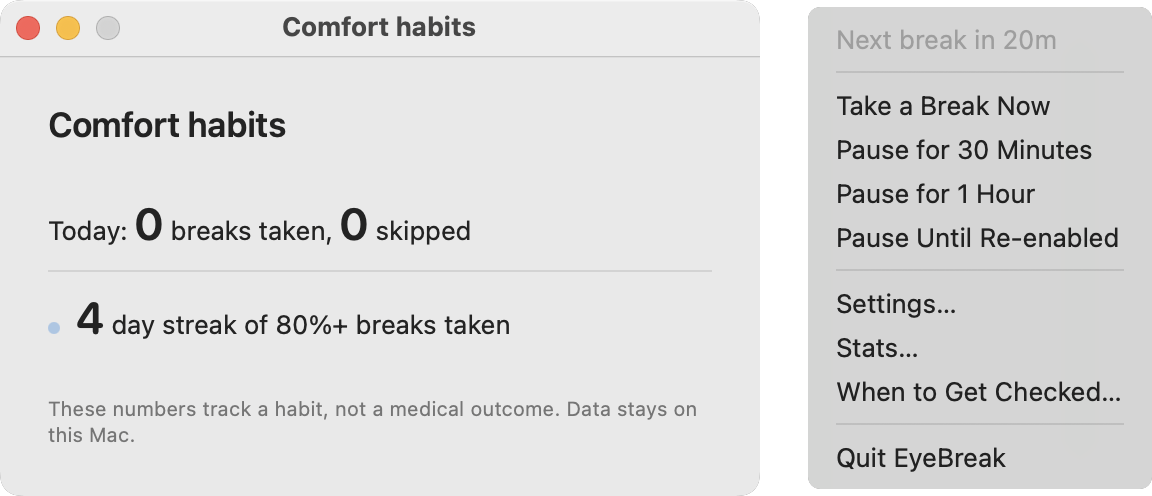
EyeBreak, captured on my own machine while building this page. A four-day streak; I use what I ship.
their problem, already solved once
A migration everyone agrees is necessary and nobody will own
Because the downside is an outage on your busiest system and the upside is that nothing visibly changes.
done
Ran one through production cutover myself across three environments. Freeze window under two minutes, zero unresolved errors, zero outages, on the platform 1,000+ engineers ship through and 20M+ people depend on.
A vendor whose API will corrupt your data quietly
Undocumented behaviour that no test catches because it fails silently and only under load.
done
Found one mid migration that would have corrupted every running A/B experiment. Drove the escalation into the vendor's own engineering org until they shipped a fix, then designed the joint cutover both companies ran.
A service the team is quietly afraid of
Red CI, no coverage, an owner who left. Every change to it is a coin flip, so changes stop.
done
Took an inherited service from a build that failed every pull request for months to 530+ tests from about 139, added timeouts and backoff on all third party calls, and merged 24 pull requests in four weeks.
Configuration sprawl that slows every release
Thousands of flags and rules nobody can safely delete, so the safe move is always to add one more.
done
Audited them across four repositories and shipped the audit as a production agent with canary verified gates and a no writes on uncertainty policy, plus eight more skills for staleness and owner routing. Dry runs caught three design defects before install.
Alerting nobody trusts any more
So real incidents arrive in a channel everyone has muted.
done
Cut automated notification noise about 330x, justified against a thousand recorded production runs rather than a sample, and it survived a 79 minute scheduler delay that would have broken the design I rejected.
An AI feature with no owner for the plumbing
The demo works. The pipeline behind it has no retries, no typed boundaries, no idea what it costs.
done
Built one end to end: async FastAPI and Celery over Postgres with pgvector, multi provider LLM routing, scheduled re-scrapes, error tracking. It replaced a four week manual process and runs a book in two to eight seconds.
The common shape: reversible change under production risk. Reduce the scary thing to a plan someone else can verify, then land it quietly.
06
The ask
I am looking for an engineering seat: AI systems, backend, full stack, or security. I want to build the new thing, the agent plumbing, the inference infrastructure, the product that does not exist yet; and I am just as good at the hard, unglamorous work that keeps it all standing.
On security, straight: I am not a career researcher. I am the engineer who found a P0 in week one, closed an audit by shipping row level security in production, and starts vulnerability research this fall. Point that at your problem and it compounds. Part time now, full time from June 2027.
start_part_time_nowAvailable
full_time_from_june_2027Available
visa_sponsorshipRequired
Two of those I control. The third only a company can flip: I am an international student and will need H-1B sponsorship for the full time seat. Part time now is the cheapest way to find out if I am any good.